Friday, November 29, 2013

ADB to provide RS. 2.9 billion for hydropower


RSS
Joint Secretary of Ministry of Finance Madhukumar Marasini (R) and Country Director of ADB Kenichi Yokoyama signing the grant agreement at the Ministry of Finance on Friday, November 29, 2013.
RSS
An agreement to this end was signed amidst a programme at the Ministry of Finance today.
KATHMANDU: The Asian Development Bank (ADB) agreed to provide a grant assistance of US dollars 21 million (equivalent to Rs. 2.9 billion) to the Government of Nepal for the development of hydropower sector.

The Ministry of Finance in a press release issued today said the assistance would be used for the implementation of the Project Preparatory Facility for hydropower projects. An agreement to this end was signed amidst a programme at the Ministry of Finance today.

The objective of the Project is to support the 10-year roadmap for hydropower development with an aim of generating an additional 10,000 megawatt of hydropower.

Large reservoir type hydropower projects are said to be helpful to achieve the above mentioned objectives. The proposed project preparatory facility aims at developing large reservoir storage hydropower projects.

The grant assistance will also be used for environmental examinations, environmental impact assessments and social impact assessments of Sunkoshi 2 (1110 mw), Sunkoshi 3 (536 mw) and update of feasibility study with detail engineering studies of the Dudh Koshi (300 mw) hydropower projects which are expected to be helpful in addressing the problem of energy crisis in the country.

The total cost of the Project is estimated at US dollar 26.25 million and the Nepal Government has to contribute 20 per cent of the total cost mostly in the form of taxes, duties, office accommodations.

The project is expected to end by June 30, 2019.

Joint Secretary at the Finance Ministry Madhu Kumar Marasini and ADB Country Director Kenichi Yokoyama signed the agreement from their respective sides. 

Wednesday, November 27, 2013

When need to consider the Vertical force of EQ ?


VERTICAL FORCES :
Eurocode8 requires vertical seismic loading to be considered in areas of high seismicityin the design of the following types of structural element
(a)beams exceeding 20m span
(b)cantilevers beams exceeding 5m
(c)prestressed concrete beams
(d) beams supporting columns
(e)base-isolated structures.
Rulesare given for the vertical response spectrum, which is independent of the soiltype. Vertical and horizontal seismic effects can be combined either using an SRSSrule or a 100%þ30%þ30%rule, similar to that discussed above for the horizontaldirections.


IBCrequires that a vertical seismic load should be considered in all structures.
This is calculated simply as a proportion of the dead load, the proportion increasingwith the seismicity of the site.

A few words from a good EQ book is:

The need to learn from earthquake damage studies and to apply good engineering sense and judgement based on this learning cannot be emphasised too strongly. It is far more important than any amount of computation and analysis.

The common sense lessons from damage studies are as follows.

(a) All frame elements must be detailed so that they can respond to strong earthquakes in a ductile fashion. Elements that are incapable of ductile behaviour
must be designed to remain elastic at ultimate load conditions.

(b) Non-ductile modes such as shear and bond failures must be avoided. This
implies that the anchorage and splicing of bars should not be done in
areas of high concrete stress, and a high resistance to shear should be
provided.

(c) Rigid elements should be attached to the structure with ductile or flexible
fixings.

(d ) A high degree of structural redundancy should be provided so that as many
zones of energy-absorbing ductility as possible are developed before a failure
mechanism is created.

(e) Joints should be provided at discontinuities, with adequate provision for
movement so that pounding of the two faces against each other is avoided.

Author: T.RangaRajan.

Tuesday, November 26, 2013

Material integration promises next generation smart devices

Researchers from North Carolina State University have integrated bismuth ferrite (BFO) as a single crystal onto a silicon chip, an advance that could lead to a new generation of multifunctional, smart devices.
BFO can be magnetised by running an electric current through the material and potential applications for it include new magnetic memory devices, smart sensors and spintronics technologies.
According to NCSU, integrating the BFO into the silicon substrate as a single crystal makes the BFO more efficient by limiting the amount of electric charge that ‘leaks’ out of the BFO into the substrate.
‘This work means we can now look at developing smart devices that can sense, manipulate and respond to data more quickly because it all happens on one chip – the data doesn’t need to be relayed elsewhere,’ said Dr Jay Narayan, John C. Fan Distinguished Chair Professor of Materials Science and Engineering at NC State and senior author of a paper describing the work.
The researchers also found that they can switch the polarity of the BFO’s magnetic field with as little as four volts, which is comparable to the voltage needed in existing integrated circuits. This is a key to developing functional technologies because higher voltages and fields are impractical and use more energy, which could damage and disrupt electronic functions.
Similarly, the researchers found that a low-strength, external magnetic field – measured at 300 Oersted – can also switch the BFO’s polarity. This is significant because external magnetic fields don’t generate heat in the BFO, which could be important for some applications.

STEMing the Engineering Brain Drain


Author:William Meiners
Purdue's renowned program continues to inspire, recruit and retain through creative approaches.
What the world may need — now more than ever — is more women engineers. In the United States alone, where women wield more than half the buying power, it makes good business sense. Why not have more women involved in designing the technology and services they're buying?
For Beth Holloway the economic logic is just one draw to the field of engineering. Success stories are another. As director of the Women in Engineering Program (WIEP) for a decade now, Holloway (BSME '92, MSME '97) has been helping share those stories and hands-on activities with K-12 audiences, along with the existing student body (both male and female) of Purdue engineering students.
The young women participating in Exciting Discoveries for Girls in Engineering (EDGE) design and build engineering-based group projects and participate in experiments during laboratory tours. Current Purdue engineering students serve as camp facilitators and mentors. Throughout EDGE and four other programs for girls from K-12, engineering is highlighted as a profession where creativity and imagination are used to solve problems for the betterment of society.
Purdue has played a historic role in the recruitment of women to engineering. Founded through the former Freshman Engineering Department in 1969, WIEP was the nation's first such organization. Purdue also has the longest continuously chartered student section of the Society of Women Engineers, which organized nationally in 1954. In 1969, when women made up less than 1 percent of Purdue's engineering student population, the goal was simply to spread the word in hopes of increasing the numbers. Holloway says that her predecessors set a goal to have 1,000 women enrolled in the various engineering disciplines after five years. They fell six short.
With Purdue's WIEP as a model and through national networks, a number of universities began their own programs to ease the path of women engineers. Though this may have taken some female engineers away from Purdue, it benefited the profession as a whole, Holloway says.
Holloway says the number of Purdue's female engineers has fluctuated over the years, the biggest boom occurring in the early 1990s. This year's freshman engineering class may be as much as 25 percent women. But the calls to increase student totals in the STEM (science, technology, engineering and math) disciplines are louder than ever. In June, President Barack Obama announced plans to train 10,000 American engineers every year.
To ensure that more of those 10,000 are young women, Holloway believes the engineering community needs to change the way it touts itself. "When we look at the data, the women who apply to engineering are absolutely academic superstars," she says. "The men who apply have a wider range of academic performance. Research indicates that more men are encouraged to go into engineering. If they tinker, for example, someone might say, "You should be an engineer.' And while their academic performance is strong, it is not as tightly clustered at the top."
The lack of encouragement from parents, guidance counselors and even the young women themselves could be keeping them away from engineering studies. WIEP outreach activities through summer camps and after-school programs are designed to spark minds for engineering as young as kindergarten.
Part of stirring the imagination for the possibilities of engineering means eliminating the misconceptions. "A lot of girls think engineering is dull, boring and nerdy," says Jennifer Groh, associate director of WIEP. "They think it's not creative and you end up working alone."
What they end up learning, Groh says, is that engineers really make things better. "They don't necessarily see what the engineers are doing because it's behind the scenes. But we really showcase how engineering makes a difference."
Exposure to engineering stories, whether it's a fifth-grader relating to the studies of a current Purdue student or an undergrad being inspired by a successful alumna, also help separate facts from fiction. Holloway remembers listening to Donna VanKlompenburg (BSME '82) and Sue Abreu (BSIDE '78) speaking to her ENGR 194 class, the Women in Engineering Seminar, which still brings in alumni to talk about their diverse careers.
"The alums are a big part of making our program as successful as it is," says Holloway, who worked as a research and development engineer at Cummins for nine years before returning to her alma mater. "I don't think we would have the outstanding participation from students that we do without that alumni involvement."
Lindsey Diggelmann, a master's student in civil engineering, will join those Purdue alumni in May 2012, no doubt with her own stories. "If you like engineering, you should definitely pursue it," says Diggelmann, who majored in oboe performance at Michigan State but ultimately got "hooked" on structural engineering. "Don't listen to anyone who says it's just a boys' club. It changes every year and there are more girls."

Engineering For Safety


Author:Della Pacheco
Drive to work, to school or on daily errands and you likely take for granted some bridges and roads built in the 1950s. But if any break down, that disturbs our routines, our safety and our economy. Purdue engineering faculty have a long history of researching infrastructure in the U.S. and around the world. Their work on assessing structural safety and developing innovative solutions makes them sought-after experts by local, state and federal government agencies as well as industry.

Metal fatigue and fracture research

Robert J. Connor, associate professor of civil engineering, has studied metal fatigue and metal fracture specifically as they relate to bridges, highway sign structures and high-mast lighting towers.
Robert J. Connor, associate professor of civil engineering, discusses high-mast tower retrofitting procedures with Ryan Sherman, a research engineer at Bowen Lab, and graduate student Lindsey Diggelmann.
Connor conducts much of his research at Purdue's Bowen Laboratory for Large-Scale Civil Engineering Research. At 66,000 square feet, it is one of only five university laboratories in the country to conduct large-scale investigations. Experts there are shaking, breaking, and even burning full-sized models to gain a greater understanding of how structures behave in crisis moments.
Much of Connor's current research is looking at the effects of wind on high-mast lighting towers — the structures lining interstate highways and high-speed roadways throughout the country. This summer Connor and two graduate students concluded a two-year study of selected towers in multiple states. Strain gauges and anemometers were installed earlier to measure wind speed and direction in order to find daily stresses on the towers. Also engineering for safety by della Pacheco | Photos by Andrew Hancock at each site was a cellular modem that worked on Verizon's 3G network sending back real-time data to a server at Purdue.
Ryan Sherman, a research engineer at Bowen Lab, and graduate student Allen De Schepper drove the mobile lab over 3,000 miles retrieving the equipment. This vehicle is an extension of the laboratory and is outfitted with computers connected to Purdue servers and equipment necessary to conduct assessments in the field.
In addition to fieldwork, tests were done in the lab on a mast tower to simulate wind conditions over a period of years. By operating the test 24/7, results on fatigue and fracture can be gained more quickly and various methods of retrofitting can be studied.
"We tested a high-mast tower in the lab that was retrofitted with bolts at the bottom," Connor says. "When you have hundreds of these by interstate highways and they begin to crack, what can you do? You can't just take them down."
The results of the studies will be sent to a panel at AAHSTO (American Association of State Highway Transportation Officials), a nonprofit, nonpartisan association representing highway and transportation departments in the 50 states, the District of Columbia and Puerto Rico.
"We write the results in specification language that is proposed to AASHTO and they will decide if they want to accept the changes and add it into the code for future design of these towers," Sherman says. "You really get to see where the rubber meets the road. You have a problem, find a solution and implement it into future design."

Testing effects of fire on steel structures

Amit Varma, associate professor of civil engineering, is a leading expert in the field of fire resistance research.
For many years Amit Varma, associate professor of civil engineering, has studied the field of fire-resistance research. Bowen Lab allows researchers like him to study the effects of fire on steel structures using a one-of-a-kind heating system and other innovative systems.
Typically such testing is conducted inside large furnaces, but Varma says that provides challenges. "It is very difficult to heat a specimen while simultaneously applying loads onto the structure to simulate the forces exerted during a building's everyday use," he says.
Varma and his research team study the effects of fire on steel structures using a oneof-a-kind heating system and other innovative systems.
To overcome this limitation, Purdue researchers designed a system made up of heating panels to simulate fire. The panels have electrical coils, like giant toaster ovens, and are placed close to the surface of the specimens. As the system is used to simulate fire, test structures are subjected to forces with hydraulic equipment.
Varma's research team is conducting a multiyear study looking at the effect of fire on steel girders used in highway bridges. The focus is on using heat to straighten, repair and rehabilitate girders damaged by collision with trucks. In the large-scale setting of Bowen Lab, the team can simulate damage and apply heat to straighten and make repairs. The results from the analytical investigations will provide design guidelines for heat straightening repairs, estimating the final residual stresses and evaluating the performance of damaged-repaired steel bridges.
Varma and Connor were called in to evaluate just such a situation after a tanker truck struck a bridge on I-465 in Indianapolis and burst into flames. Increasing truck traffic on highways could mean more such incidents.
The team uses coils to simulate fire and then uses heat to straighten, repair and rehabilitate bridge girders.
But not all failures in bridges are related to intense heat. Growing vehicular traffic and increased weight are causing stress on aging bridges. Through field instrumentation, Connor and his students install sensors on bridges to study stresses and recommend retrofits that can keep a small problem from becoming a catastrophic one.
To study this in the lab, a full-scale bridge deck was constructed and on it was a two-axle vehicle loaded down with the weight that a tractor-trailer would carry. Day after day the vehicle was moved back and forth, simulating the load on the bridge.
Inside and underneath, about 200 sensors were installed, strain gauges that show how the concrete stretches and compresses beneath the truck's weight. A laser tracked the truck's position. By shifting the truck's path from one side to the other, the test provided a full look at how the bridge twists and bends under pressure.
"It allowed us to see how the bridge reacts in real life," Connor says. "We took that data and compared it to computer models. That data allows us to improve the safety, reliability and durability of bridges so that we can have better infrastructure that will last us decades."
But what they do in the laboratory is only part of the picture. Sensors also are installed on different types of bridges and monitored to "let those structures tell us how are responding over time," Connor says.

History lessons for engineers

The old adage says, "Those who cannot remember the past are condemned to repeat it." In the case of infrastructure, many of the people responsible for repairing and maintaining roads and bridges weren't even born when the structures were built. That's why it's important, Connor says, to teach students about older materials while at the same time studying new high-performance ones.
"A lot of bridges we work on were built in the 1940s and 50s," Connor says. "If you don't know the issues from the past, then you will have a difficult time figuring out what the problems are and making sure that you don't repeat them in the future. There is a need for students to know what was done in the past, why we aren't using certain materials or designs anymore, or why we continue to use them."
Sherman agrees. He cites the Tacoma Narrows bridge in Washington as a good example. Built in 1940 and nicknamed "Galloping Gertie," it collapsed four months after it opened due to vertical movement of the bridge deck. Sherman says, "Knowing the past and doing the research for the future is where it all comes together to improve safety."

Study: Online tools accelerating earthquake-engineering progress


Pujol Haiti earthquake
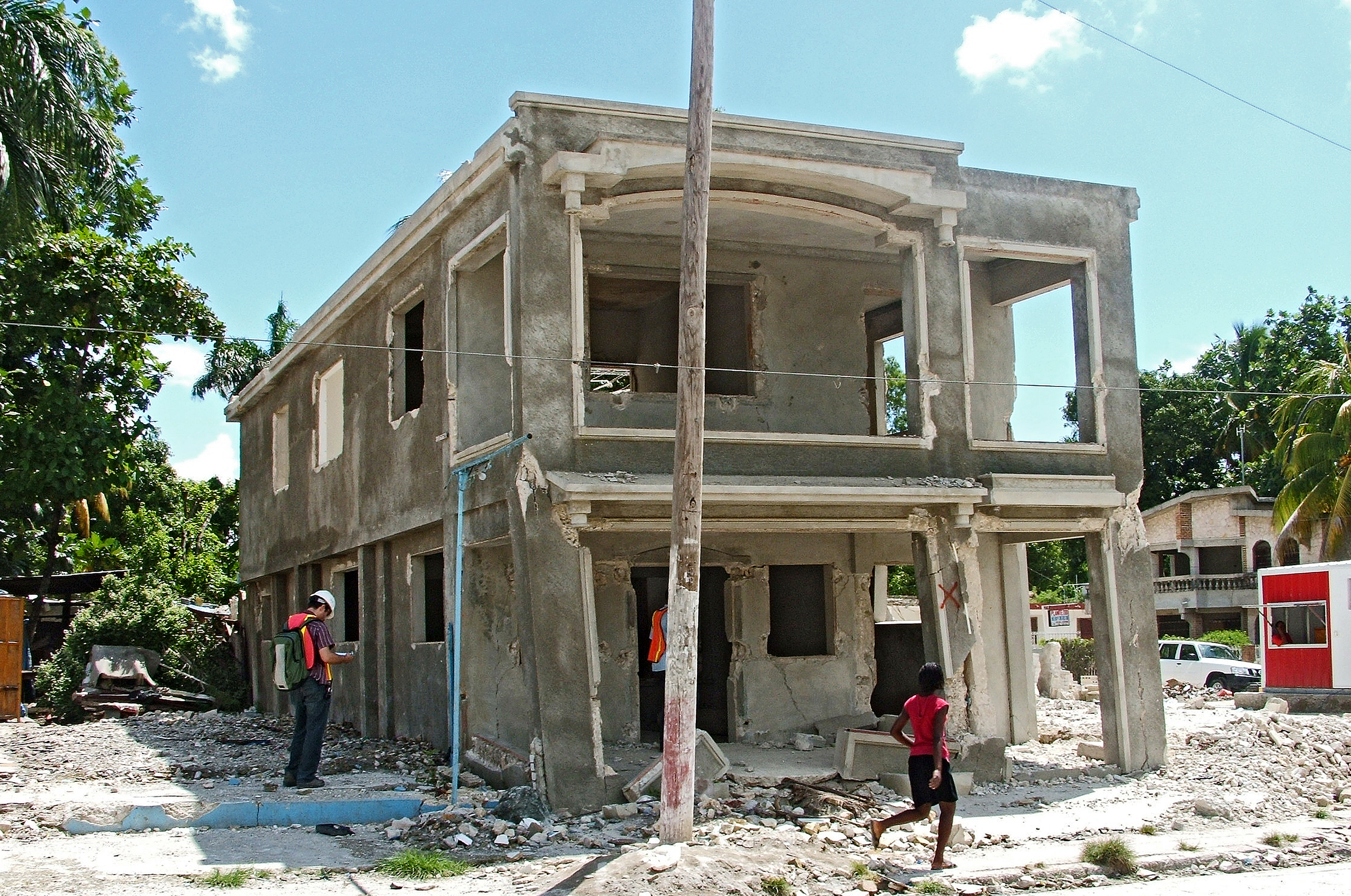
Santiago Pujol, at far left, a Purdue associate professor of civil engineering, surveys a private residence damaged in a Haiti earthquake. The building was among 170 surveyed by civil engineers studying the effects of the January 2010 earthquake. Such photos and research-related information regarding earthquakes are part of a database maintained and serviced by the National Science Foundation's George E. Brown Jr. Network for Earthquake Engineering Simulation (NEES), based at Purdue. (Purdue University photo/Kari T. Nasi) 
Download Photo
WEST LAFAYETTE, Ind. — A new study has found that online tools, access to experimental data and other services provided through "cyberinfrastructure" are helping to accelerate progress in earthquake engineering and science.
The research is affiliated with the National Science Foundation's George E. Brown Jr. Network for Earthquake Engineering Simulation (NEES), based at Purdue University. NEES includes 14 laboratories for earthquake engineering and tsunami research, tied together with cyberinfrastructure to provide information technology for the network.
The cyberinfrastructure includes a centrally maintained, Web-based science gateway called NEEShub, which houses experimental results and makes them available for reuse by researchers, practitioners and educational communities.
"It's a one-stop shopping site for the earthquake-engineering community to access really valuable intellectual contributions as well as experimental data generated from projects at the NEES sites," said Thomas Hacker, an associate professor in the Department of Computer and Information Technology at Purdue and co-leader of information technology for NEES. "The NEES cyberinfrastructure provides critical information technology services in support of earthquake engineering research and helps to accelerate science and engineering progress in a substantial way."
Findings from a recent study about cyberinfrastructure's impact on the field were detailed in a paper published in a special issue of the Journal of Structural Engineering, which coincides with a NEES Quake Summit 2013 on Aug. 7-8 in Reno. The paper was authored by Hacker; Rudolf Eigenmann, a professor in Purdue's School of Electrical and Computer Engineering; and Ellen Rathje, a professor in the Department of Civil, Architectural, and Environmental Engineering at the University of Texas, Austin.
A major element of the NEES cyberinfrastructure is a "project warehouse" that provides a place for researchers to upload project data, documents, papers and dissertations containing important experimental knowledge for the NEES community to access.
 "A key factor in our efforts is the very strong involvement of experts in earthquake engineering and civil engineering in every aspect of our IT," Hacker said. "The software we develop and services we provide are driven by user requirements prioritized by the community. This is an example of a large-scale cyberinfrastructure project that is really working to address big-data needs and developing technologies and solutions that work today. It's a good example of how cyberinfrastructure can help knit together distributed communities or researchers into something greater than the sum of its parts."
The effort requires two key aspects: technological elements and sociological elements.
"The technological elements include high-speed networks, laptops, servers and software," he said. "The sociology includes the software-development process, the way we gather and prioritize user requirements and needs and our work with user communities. To be successful, a cyberinfrastructure effort needs to address both the technology and social elements, which has been our approach."
The project warehouse and NEEShub collects "metadata," or descriptive information about research needed to ensure that the information can be accessed in the future.
"Say you have an experiment with sensors over a structure to collect data like voltages over time or force displacements over time," Eigenmann said. "What's important for context is not only the data collected, but from which sensor, when the experiment was conducted, where the sensor was placed on the structure. When someone comes along later to reuse the information they need the metadata."
The resources are curated, meaning the data are organized in a fashion that ensures they haven't been modified and are valid for reference in the future.
"We take extra steps to ensure the long-term integrity of the data," Hacker said.
NEEShub contains more than 1.6 million project files stored in more than 398,000 project directories and has been shown to have at least 65,000 users over the past year. Other metrics information is available at http://nees.org/usage.
"We are seeing continued growth in the number of users," Rathje said. "We are helping to facilitate and enable the discovery process. We have earthquake engineering experts and civil engineering experts closely involved with every aspect of our IT and cyberinfrastructure, and we are constantly getting feedback and prototyping."
To help quantify the impact on research, projects are ranked by how many times they are downloaded. One project alone has had 3.3 million files downloaded.
"We have a curation dashboard for each project, which gives the curation status of the information so that users know whether it's ready to be cited and used," Hacker said.
The site also has a DOI, or digital object identifier, for each project.
"It's like a permanent identifier that goes with the data set," he said. "It gives you a permanent link to the data."
NEES researchers will continue to study the impact of cyberinfrastructure on engineering and scientific progress.
"The use and adoption of cybeinfrastructure by a community is a process," Hacker said. "At the beginning of the process we can measure the number of visitors and people accessing information. The ultimate impact of the cyberinfrastructure will be reflected in outcomes such as the number of publications that have benefited from using the cyberinfrastructure. It takes several years to follow that process and we are in the middle of that right now, but evidence points to a significant impact."
Writer: Emil Venere, (765) 494-4709, venere@purdue.edu
Sources: Thomas Hacker, 765-494-4465, tjhacker@purdue.edu
Rudolf Eigenmann, 765-494-1741, eigenman@purdue.edu
Ellen Rathje, 512-232-3683, e.rathje@mail.utexas.edu
Note to Journalists: Information about the NEES annual Quake Summit 2013 is available athttp://nees.org/quakesummit2013. An electronic copy of the research paper is available from Emil Venere, (765) 494-4709, venere@purdue.edu

ABSTRACT
Advancing Earthquake Engineering Research through Cyberinfrastructure  
Thomas Hacker 1; Rudolf Eigenmann 2; and Ellen Rathje, M.ASCE Network Earthquake Engineering Simulation Hub:
1 Associate Professor, Computer and Information Technology, National
Science Foundation George E. Brown, Jr. Network for Earthquake Engineering Simulation, Purdue University (corresponding author). E-mail: tjhacker@purdue.edu 
Professor, School of Electrical and Computer Engineering, NEES
3 Professor, Department of Civil, Architectural, and Environmental Engineering, NEES, Univ. of Texas, Austin
This paper describes the cyberinfrastructure (CI) of the George E. Brown, Jr. Network for Earthquake Engineering Simulation (NEES) and examines the evidence that this infrastructure is facilitating earthquake engineering research. Among the key features of the CI are the NEES Project Warehouse (PW), which is a data repository for earthquake engineering, an environment that supports the use of tools for web-based data analysis and simulation, and tools that support research collaboration. The value that such CI offers to the user community is discussed. The CI also gathers a myriad of usage statistics, some of which are presented in this paper. Among them are the number of users, pageviews, recorded NEES projects, and other stored resources. This information demonstrates that the CI is used significantly and increasingly so. DOI: 10.1061/(ASCE)ST.1943-541X.0000712. © 2013 American Society of Civil Engineers.

VACANCY FOR STRUCTURAL/BRIDGE DESIGN ENGINEER

Swiss Agency for Development and Cooperation (SDC) in Nepal is providing Technical Assistance (TA) and grant supports to the Government of Nepal (GoN) through Ministry of Federal Affairs and Local Development and its Department of Local Infrastructure Development and Agricultural Roads to implement of District Roads Support Programme (DRSP) – Phase IV and Local Roads Bridge Programme (LRBP) – Phase I in different districts of Nepal.
 ITECO Engineering Ltd., Switzerland, on behalf of the Swiss Agency for Development and Cooperation (SDC) has set up a technical team at central and district levels to support the GoN in implementing the activities of DRSP and LRBP. To supplement its technical team, ITECO Engineering Ltd. seeks applications from suitably qualified and experienced Nepali nationals for the positions below:
1. BRIDGE DESIGN ENGINEER (BDE): one position
Qualification and ExperienceAn engineer, preferably with a Masters Degree or equivalent in structural / bridge engineering, with a minimum 7 years experience. The candidate must have capability to design bridge, verify the design and implement the design during the construction. S/He should have designed independently at least five major bridges of different types such as motorable suspension, arch, truss, compact, pre-fabricated bridges etc. S/he must have knowledge of bridge construction supervision and contract management and at least 5 years experience in construction supervision / contract management. Experience of planning & monitoring geo-technical and hydraulic investigations for the bridges and interpreting the findings thereof, formulation and implementation of Work Schedule / Quality Assurance Plans will be an added advantage.S/he shall have very good written and spoken English. Experience in applications like MS Project will be added advantage.
TOR can be downloaded from the link below.
http://lrbpnepal.org/uploaded/2013_11_18%20TOR%20for%20Bridge%20Design%20Engineer.pdf

3TECHNICAL AND DESIGN ENGINEER (TDE): one position

Qualification and ExperienceAn engineer, preferably with a Masters’ degree with a minimum 10 to 12 years of experience of working in road sector programmes (including knowledge of rural roads sector policies and strategies, surveying, designing, construction management and contracts management) at senior levelAdditional degree in management related field will be preferred. The candidate must have capability to assist the CTA/TL with the planning, monitoring and implementation of operation of the programme. S/he shall have very good written and spoken English. Required Social/behavioral competence for all the positions:

§ Reasoning skills
§ Good Interpersonal skills
§ Able to work and contribute positively in a team
§ Sensitive to gender and social inclusion
§ Ability to work in a multi-cultural team
TOR can be downloaded from the link below.
http://lrbpnepal.org/uploaded/2013_11_18%20TOR%20Technical%20and%20Design%20Engineer.pdf
Terms of Reference: The detailed terms of reference can be obtained by e-mail: drsp@drspnepal.org or lrbp@lrbpnepal.orgor downloaded from www.drspnepal.org or www.lrbpnepal.orgThe closing date for applications is December 08, 2013. Only short-listed candidates will be invited for an interview and further assessments. No telephone calls, written or personal enquiries will be entertained in this regard. Interested candidates are requested to send their application with CV to the Chief Technical Adviser, DRSP or LRBP, PO Box 113, Kathmandu or by e-mail to vacancy@lrbpnepal.org or by fax to 5-543144.Please clearly mark “Application for FM/BDE/TDE” on the envelope / subject of the email.

शंकास्पद कारोबार पत्ता लगाउन सफ्टवेर ल्याईंदै

११ मंसिर काठमाडौं । शंकास्पद कारोबारबारे अनुसन्धान गरी सम्पत्ति सुद्धिकरण अनुसन्धान विभागलाई सूचना दिँदै आएको वित्तीय जानाकारी इकाइले संकास्पद कारोबारको स्वत विश्लेषण र रिपोर्टिङ गर्ने सफ्टवेर ल्याउने तयारी गरेको छ । संयुक्त राष्ट्र संघको युएनओडीसीले निर्माण गरेको ‘गो एम एल’ सफ्टवेर ल्याउने तयारी भइरहेको इकाइका प्रमुख मुकुन्द महतले जानकारी दिनुभयो । महतका अनुसार आगामी बैशाखसम्ममा उक्त सफ्टवेर प्रयोगमा ल्याइनेछ ।
blackmoneyउक्त सफ्टवेरको प्रयोगपछि ग्राहकले बैंकमा खाता खोल्दा दिएको विवरणअनुसार कारोबारको आकार अपत्यारिलो भए उक्त सूचना स्वतः सम्बन्धित निकायमा पठाउँछ । ‘सफ्टवेरले ठूलो मात्राको तथ्यांकको विश्लेषण गरी स्वतः सम्बिन्धत ठाउँमा रिपोर्टिङ गर्ने भएकाले तीव्र गतिमा काम अघि बढ्छ र अन्तराष्ट्रिय समूदायसँग पारदर्शि हुन्छौं ।’ महतले भन्नुभयो । सफ्टवेर प्रयोग गरेबापत पहिलो वर्ष १ लाख डलर, दोस्रो र तेस्रो वर्षर् ८० हजार डलर तिर्नुपर्ने र चौथो वर्षदेखि नयाँ भर्सन प्रयोग गर्न मात्रै चार्ज तिर्नुपर्ने उहाँको भनाई छ ।
संसारभरका अधिकांश वित्तीय जानकारी इकाई र अन्तराष्ट्रिय मुद्रा कोष -आइएमएफ)ले यही सफ्टवेरको प्रयोग गर्दै आएका छन् । अन्तराष्ट्रिय समुदायकै दबाबमा राष्ट्र बैंकले गो एम एलसफ्टवेर ल्याउने निर्णय गरेको हो ।यसअघि सफ्टवेयर खरिदका लागि बोलपत्र आह्वान गरेपनि खरिद गर्न असफल भएपछि राष्ट्रबैंकले आफैले बोलपत्र आह्वान नगरि किन्न लागेको हो ।गैरकानूनीरुपमा आर्जित सम्पत्तिलाई सेतो धनमा रुपान्तरण गर्न नदिन र सेतो धनलाई लागूऔषध तथा आतंककारी गतिविधिमा लगानी हुन नदिन बनेको ऐन ‘सम्पत्ति सुद्धिकरण निवारण ऐन २०६४’ को कार्यान्वयन गर्ने क्रममा बैंक तथा वित्तीय संस्थामा भएको कारोबारबारे जानकारी लिन राष्ट्र बैंकले वित्तीय जानकारी इकाई गठन गरेको थियो ।